Back
S3
THIRD NATURE
-
Design team:
Dmitry Dubrovsky, Kira Radyuk
-
Client:
Splaces Studio
-
Location:
Saint-Petersburg, Lakhta Center
-
Type:
exposition
-
Design:
2026
-
Construction:
2026
-
Photo:
Daniil Zherdev
-
Design team:
Dmitry Dubrovsky, Kira Radyuk
-
Client:
Splaces Studio
-
Location:
Saint-Petersburg, Lakhta Center
-
Type:
exposition
-
Design:
2026
-
Construction:
2026
-
Photo:
Daniil Zherdev
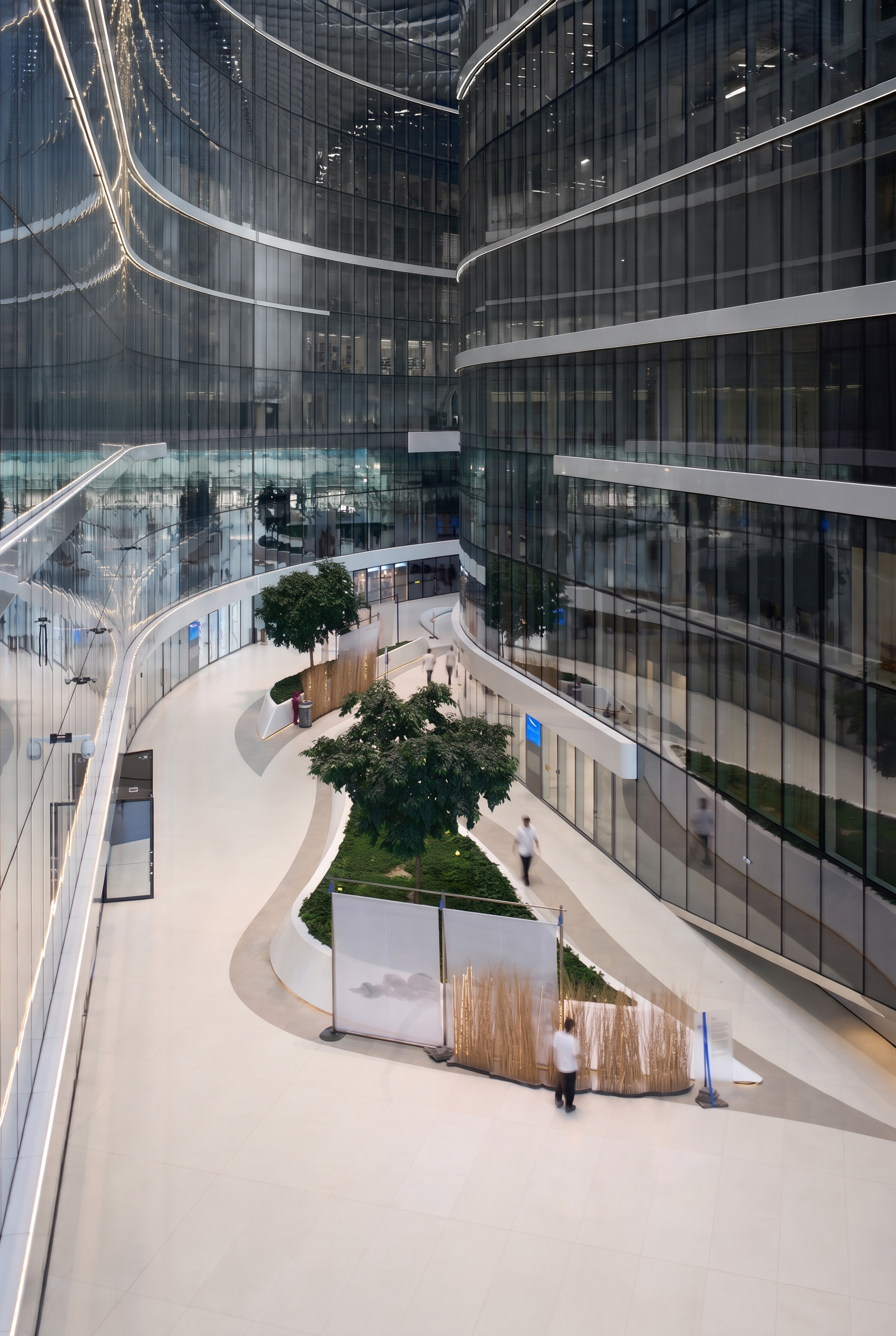
For the exhibition The Third Nature — a project by our friends at SPLACES, supported by Gazprom’s Foundation for the Support of Cultural Initiatives — we were responsible for the architectural design of the exhibition.
The atrium of Lakhta Center is an open space with a strong technological and tectonic character. Our approach to the exhibition architecture was guided primarily by the principle of non-intervention: introducing carefully considered elements through precise, minimal interventions. Rather than transforming the environment, we sought to reinterpret it. The exhibition structures were designed to integrate seamlessly into the existing context, preserving its rhythm and openness.
Our task was not simply to arrange the sculptures, but to create an intuitive route that would guide visitors through the exhibition, allowing them to experience it as a sequence. The starting point was a haiku by Matsuo Bashō:
An old pond—
a frog jumps in.
The sound of water.
We saw it as a metaphor for the tension between stillness and an instantaneous event — a moment in which a small gesture transforms perception. This idea became the leitmotif behind a system of backdrops inspired by the Japanese kichō folding screen.
We designed the exhibition so that the architecture would not compete with the sculptures, but rather enhance their presence. Individual objects came together to form a continuous narrative, while the space itself became part of the story.
The choice of materials was based on contrast. The metal framework echoes the tectonic language of the building’s façade, while the translucent chiffon fabric, featuring sublimation printing, softens its graphic character.
At approximately four metres in height, the screens needed to remain visually light. Instead of using large-section square steel tubes, we opted for paired flat steel sections, each only around 10 millimetres thick, welded together with regularly spaced crosspieces. Circular-section tubes were threaded through these openings, providing support for the fabric tracks. We used industrial lifting slings for the suspension system; these also serve to hold the descriptive labels accompanying each sculpture.
Light became a material in its own right, just like metal and fabric. Before construction, we measured the atrium's illumination at different times of day to ensure that the installation would respond naturally to changing daylight conditions.
Gobo-equipped luminaires were mounted on the screen structures. Using AI-based tools, we developed a unique lighting pattern for each image: shadows of tree canopies, reeds, meadow grasses and reflections on water emerge across the fabric.
The exhibition culminates in Megalith — a stone-shaped sculpture that evokes geological time. Artificial intelligence embedded within the object transforms visitors' touches into sounds reminiscent of forest landscapes. The stone becomes a musical instrument, allowing visitors to hear the slow rhythms of the Earth and enter into a dialogue with them.
Due to the structural load restrictions on the floor slab, the weight of the sculpture had to be distributed across a supporting structure. We designed a cubic framework made of slender metal tubes, from which the magnesite object, weighing just under 700 kilograms, is suspended by cables. In this way, the structure fulfils an engineering requirement while simultaneously establishing a distinct architectural presence for the sculpture.